Sustainable Seas Institute closes out its 2026 field season with two research projects: a partner-led microplastics sampling voyage across the Baltic Sea and an R/V Dawn science cruise from the British Virgin Islands to the Dominican Republic. Samples from both projects feed SSI’s growing global dataset on PFAS and microplastic contamination.
2
Remaining 2026 field projects
Nov 14 to Dec 3
Baltic Sea sampling voyage
Dec 16 to Dec 30
R/V Dawn Caribbean cruise
Project 1 · Partner expedition
From the Baltic to the Bench: microplastics in an enclosed sea
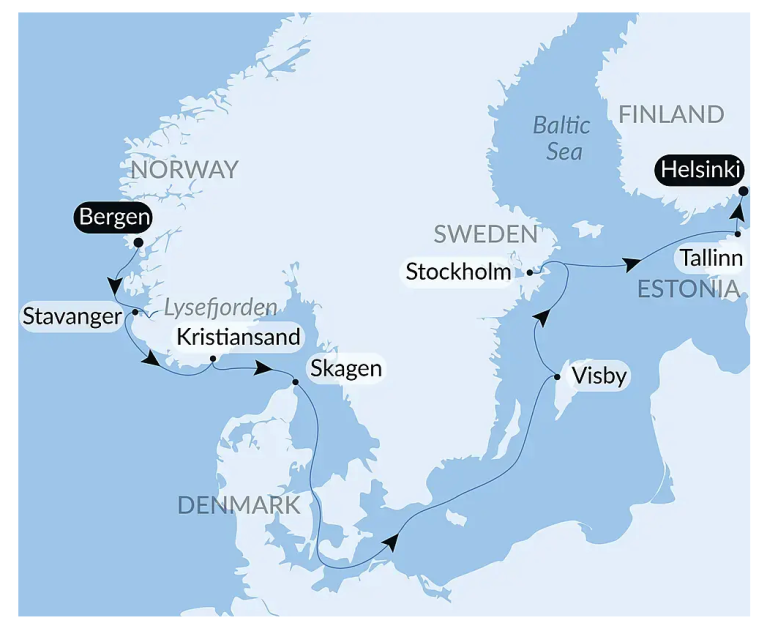
SSI co-PI Dr. Ulyana Horodyskyj Pena of Science in the Wild and the University of Colorado Boulder will sail with the PONANT Science program aboard Le Commandant Charcot, a Polar Class 2 icebreaker with two onboard laboratories. Along the way she will collect seawater samples from the Norwegian coast to the inner Baltic Sea.
The Baltic is shallow, brackish, and semi-enclosed, with a densely populated watershed and very slow exchange with the open ocean. Plastic that enters it tends to stay there, which makes it a natural laboratory and a strong contrast to the Caribbean, open ocean, and Arctic waters SSI has already sampled.
At a glance
- Dates: November 14 to December 3, 2026
- Platform: Le Commandant Charcot, PONANT Science program
- Leg 1: Bergen, Stavanger and the Lysefjord, Kristiansand, Skagen, the Danish straits, Visby, Stockholm, and Tallinn to Helsinki
- Leg 2: A Baltic loop from Helsinki through Stockholm, Visby, Gdansk, Riga, and Tallinn, returning to Helsinki
- Sampling: Niskin bottle seawater samples spanning a salinity gradient from the North Sea coast into the Gulfs of Finland and Riga
- Analysis: Particle counts, polymer identification, and particle shape (convexity and solidity) at the Performance Materials Laboratory, UNC Charlotte
- Data: Results will be added to GOCOS, SSI’s open-source ocean contamination platform
The central question is whether the shapes of microplastic particles in a heavily used, enclosed sea differ from those found elsewhere. Particle geometry, not just size or chemistry, appears to influence biological effects, so these samples help connect where plastic accumulates to how harmful it may be.
Project 2 · R/V Dawn expedition
R/V Dawn: British Virgin Islands to the Dominican Republic
After hurricane season maintenance and upgrades in Virgin Gorda, R/V Dawn returns to sea for a two-week science cruise west from the British Virgin Islands to the Dominican Republic. The route works island to island, with sampling stops along the way that extend SSI’s Caribbean station network.
Dawn is a 39-foot Camper and Nicholson ketch that cruises at five to six knots, which lets the crew collect samples at a deliberate pace and anchor close to the coastal waters where land-based contamination enters the sea.

At a glance
- Dates: December 16 to December 30, 2026
- Vessel: R/V Dawn, SSI’s sailing research vessel
- Route: British Virgin Islands to the Dominican Republic, stopping at islands along the way
- Sampling: Surface seawater for PFAS and microplastics at each stop
- Data: New stations added to the Caribbean map in GOCOS
2026 field season at a glance
| When | Project | Status |
|---|---|---|
| June | R/V Dawn cruise: St. Martin and the British Virgin Islands | Completed |
| Summer and fall | R/V Dawn haul out, maintenance, and upgrades in Virgin Gorda | Underway |
| November 14 to December 3 | Baltic Sea microplastics sampling aboard Le Commandant Charcot | Upcoming |
| December 16 to December 30 | R/V Dawn cruise: British Virgin Islands to the Dominican Republic | Upcoming |
Completed in June: R/V Dawn sailed from St. Martin across the Anegada Passage to the British Virgin Islands, collecting water samples before hauling out in Virgin Gorda for hurricane season.
Follow the data
Every sample from these projects becomes part of GOCOS, SSI’s open-source platform for monitoring PFAS and microplastics across the world’s oceans. Explore the stations and datasets, or partner with us to extend the map.