Education
Undergraduate research at sea
SSI brings undergraduate researchers into active ocean science: collecting water samples aboard R/V Dawn, analyzing PFAS and microplastics data, and building computer models of how contamination moves through the ocean. You collect real samples, build real models, and contribute to real science.
R/V Dawn
Sailing research vessel
UNC Charlotte
Partner university
GOCOS
Open ocean data platform
3
Research pathways
The program
What SSI offers undergraduate researchers
SSI’s undergraduate research model is built on real fieldwork and real data. Students take part in the same science that produces peer-reviewed publications: operating sampling equipment aboard R/V Dawn, running contamination transport models with Caribbean field data, and presenting findings at academic symposia.
The program is integrated with UNC Charlotte’s undergraduate research opportunities and is open to students from partner institutions. Student work feeds directly into GOCOS, SSI’s open-source platform for PFAS and microplastics data from the world’s oceans.

Research pathways
Three ways to get involved
Field expeditions
Work aboard R/V Dawn collecting water samples, operating instruments, and recording station data in the Caribbean and beyond.
At sea
Ocean modeling
Build and run MITgcm contamination transport models using SSI field data to simulate PFAS pathways across the Caribbean and the world’s oceans.
Computational
Data, symposia, and publication
Analyze and visualize contamination data, present findings at UNC Charlotte’s undergraduate research symposia, and contribute to peer-reviewed publications.
Academic
Student spotlights
Recent undergraduate research

Sam Phillips: modeling ocean contamination
A UNC Charlotte Honors College undergraduate, Sam used the MITgcm ocean circulation model to simulate how water contamination spreads through the world’s oceans and presented the work at the Honors College Undergraduate Research Symposium.
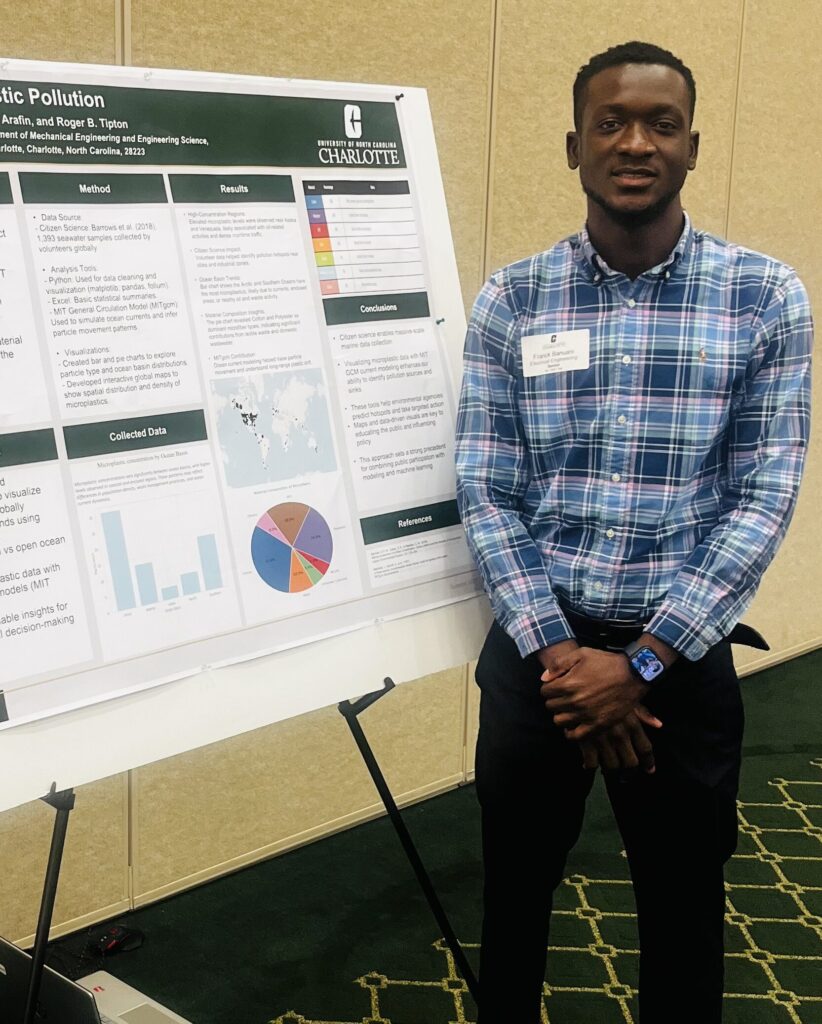
Franck: visualizing global ocean pollution
Franck’s summer project focused on visualizing pollution concentration data across the world’s oceans. He presented his findings at the UNC Charlotte Summer Undergraduate Research Symposium.
What you gain
Skills and credentials
- Field water sampling protocols (EPA 533/537.1)
- Marine instrument operation at sea
- Academic symposium presentation
- Caribbean marine ecosystem knowledge
- MITgcm ocean circulation modeling
- Scientific data QA/QC and management
- Contribution to peer-reviewed research
- PFAS and microplastics science literacy
Current research students can connect to
- R/V Dawn Caribbean cruise, December 16 to December 30, 2026: water sampling from the British Virgin Islands to the Dominican Republic
- Baltic Sea microplastics: samples collected aboard Le Commandant Charcot this November and December return to UNC Charlotte for analysis
- GOCOS: open PFAS and microplastics datasets for analysis, visualization, and modeling projects
Common questions
FAQ
Do I need prior research experience?
No. SSI selects for curiosity, reliability, and willingness to learn. All field and modeling methods are taught during onboarding.
Can I earn academic credit?
UNC Charlotte students can arrange independent study or research credit through their department. We support the paperwork.
Are positions paid?
Expedition positions include travel and accommodations aboard R/V Dawn. Stipend availability depends on current grant funding.
Can students from other universities apply?
Yes. Modeling positions are open to any institution. Expedition positions require institutional coordination, so contact us to discuss.
Ready to join the research?
Tell us about your interests, your institution, and whether you are drawn to fieldwork, modeling, or data analysis. We will follow up about current openings.